SPADE: Self-Play in Adaptive Synthetic Executable Environments
An overview of our paper, SPADE (Self-Play in Adaptive Synthetic Executable Environments). SPADE is the next step in our line of work on self-play for large language models, following SPIRAL and SPICE. Where SPIRAL sharpened reasoning inside a handful of fixed zero-sum games, and SPICE grounded the self-play loop in a document corpus to pose harder tasks, SPADE lets a single model design the training worlds themselves: an Environment Designer writes complete, long-horizon environments as executable Python implementing a Gym-style reset()/step() interface, and a Reasoning Agent learns to act in them. A hint-based regret reward trains the Designer to keep every environment solvable but right at the edge of the Agent's ability, so the curriculum keeps moving as the learner improves. The same recipe lifts both reasoning and multi-turn agentic tool use, by +5.3 over the strongest fixed-environment baseline at 30B scale, with a margin that grows with model size.
Motivation: The Environment Is Still Fixed
Continuous self-improvement requires an ever-expanding pool of self-generated, diverse, adaptive goals. That single sentence is the thread that runs through this whole line of work. In SPIRAL
I ended both of those posts with the same promise. SPIRAL’s closing section imagined “self-play between actor and environment, where the environment itself becomes another learner that generates increasingly challenging problems.” SPICE’s closing section said the constraint that remained was the environment itself, still fixed, and that the next step was “to make the environment a learnable component that co-evolves with the agent, so the curriculum scales with the learner rather than being capped by a fixed corpus or a fixed game.” SPADE is that step.
The environment matters now because the target has moved. The frontier is no longer single-turn reasoning; it is agents that act over long horizons, calling tools, browsing, and operating software across many turns
Core Insight: An Environment Is Just Code
reset()/step() interface, a full multi-turn MDP with its own state transitions, reward function, and verification logic. In the Reasoning Agent role, the same model learns to act in it. Because any computable MDP can be written as a program, the space of environments the Designer can reach is bounded only by the model's coding ability, not by a hand-designed parameterization. And because the Designer is trained, by a hint-based regret reward, the environment distribution co-evolves with the Agent instead of staying frozen. This is the move I kept circling in the earlier posts, now made concrete. SPIRAL’s environments were three human-written games. SPICE’s were questions mined from documents. Both are still, in the end, worlds someone else specified. The code-as-environment representation lets the model specify the world itself. The interface is tiny: reset() returns the first observation, and step(action) returns the next observation, a reward, and whether the episode is done
Making the designer a learner, rather than a fixed generator, is the oldest idea in this lineage. PowerPlay
What does making the designer a learner actually buy you? The rest of this post lays out the method and then four results. Self-designed environments beat fixed ones, and the advantage grows as models scale. The Designer genuinely adapts, making its worlds harder as the Agent improves. Every ingredient (Designer training, corpus grounding, environment memory) is load-bearing. And the same recipe carries from reasoning puzzles to multi-turn tool use. Underneath all four is one claim: environment design is the first hand-built stage of the training loop that SPADE hands to the model.
How SPADE Works
Dual-Role Self-Play and Code-as-Environment
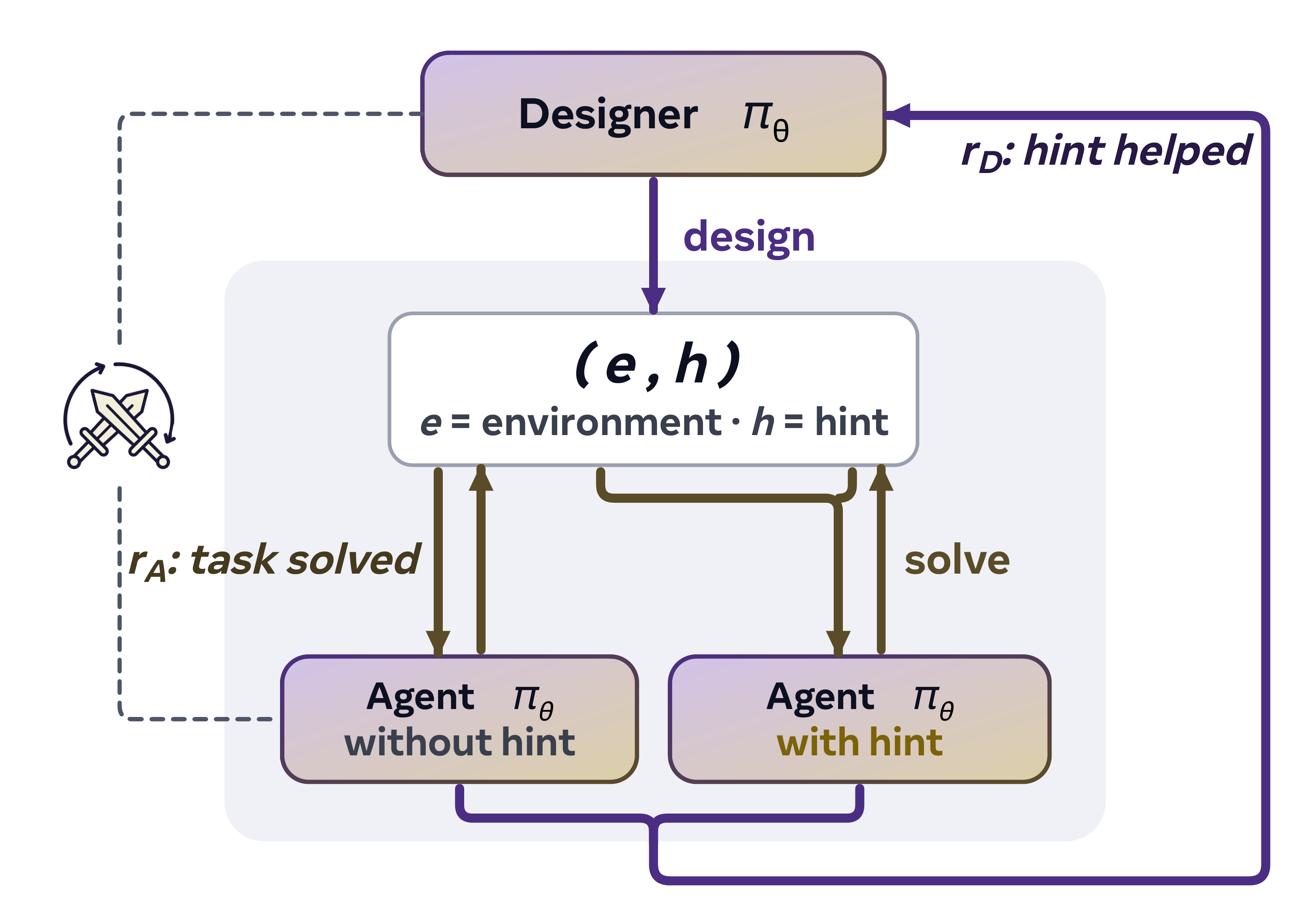
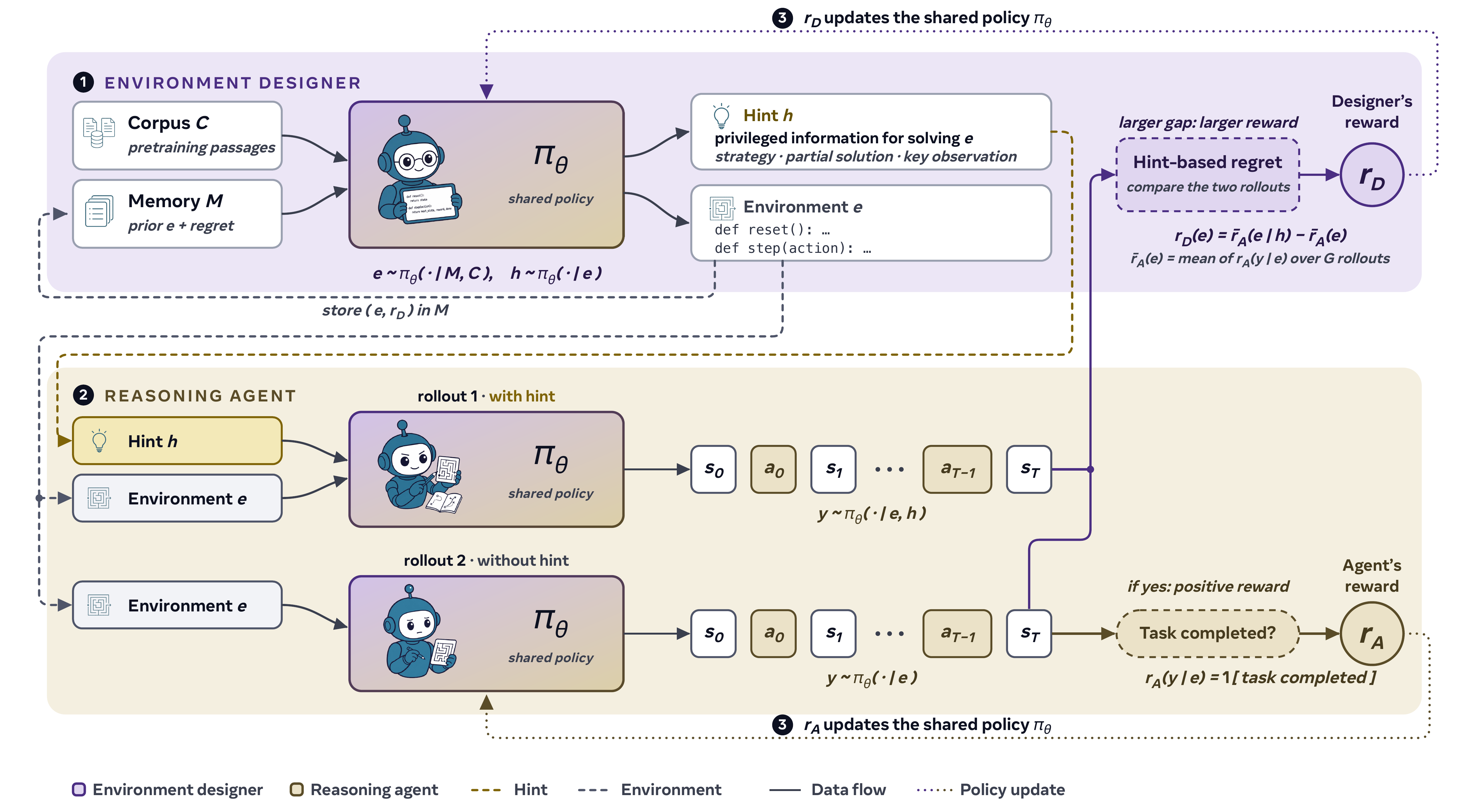
A single policy acts in two roles, selected by a system prompt: designing environments or solving them. In the Designer role it produces an executable environment as a Python program whose step() encodes both the transition function and the reward function, and it also writes a short privileged hint for that environment. In the Agent role, the same weights interact with the environment turn by turn, receiving observations and rewards. Both roles share parameters and are updated jointly with GRPO
Here is the flavor of what the Designer emits, a Wordle-style deduction game as a single stateful class in the exact format it produces:
def reset(self, seed=None): # initial state
self.target = choice(WORDS); self.turns_left = 6
return "Guess a 5-letter word in 6 tries.", {}
def step(self, guess): # (obs, reward, terminated, truncated, info)
self.turns_left -= 1
fb = feedback(guess, self.target)
if fb == "GGGGG": return fb, 1.0, True, False, {}
return fb, 0.0, False, self.turns_left == 0, {}
The real environments the Designer writes at 30B scale are far richer than this: a family-dispute negotiation with hidden legal state that only pays out once the title is secured, or a thermodynamics lab where the Agent must run a three-step gas cycle and discover that the net entropy change is zero. Same interface, unbounded content.
Hint-Based Regret: Aiming at the Frontier
The whole system turns on one question: how do you reward the Designer? A pure adversary is free to make environments unsolvable; a cooperative designer can inflate the Agent’s reward without teaching it anything. SPADE’s answer is hint-based regret. For each environment, the Designer also writes a privileged hint, a sentence or two of strategy or a partial solution, and the reward is the gap between the Agent’s success with the hint and without it:
r_D(e) = mean_return_with_hint(e) − mean_return_without_hint(e)
Three regimes fall out of this one number. A high gap means the environment is right at the frontier: solvable with the hint, not without, exactly where the Agent has the most to learn. A low gap with high returns means the Agent has already mastered it. A low gap with low returns even with the hint means the environment is intractable and teaches nothing. Rewarding the gap steers the Designer toward the first regime and away from the other two. This is the minimax-regret objective of PAIRED
Corpus for Breadth, Memory for Difficulty
A generator conditioned only on its own output has no source of novelty outside its weights, so it narrows toward the patterns it already favors, the invisible leash again. SPICE established the fix for task generation: ground every round in freshly sampled human corpus. SPADE carries that principle to environment generation, where a sampled passage seeds an executable MDP rather than a question-answer pair. But SPADE adds a second input that SPICE did not have: an environment memory. The corpus supplies breadth, deciding what the environments are about; the memory supplies difficulty, deciding how hard they are. It is a buffer of previously generated environments annotated with their regret scores and skill tags, so each round the Designer starts from the high-regret environments the Agent currently finds hard, varying them, rather than starting from scratch and re-posing what the Agent has already outgrown. As we will see, removing either one costs real points.
Self-Designed Environments Beat Fixed Ones
We train three Qwen3 backbones (4B, 8B, and 30B-A3B, the last our primary model) and compare against two fixed-environment baselines that share SPADE’s base model, GRPO hyperparameters, and compute budget: RLVE
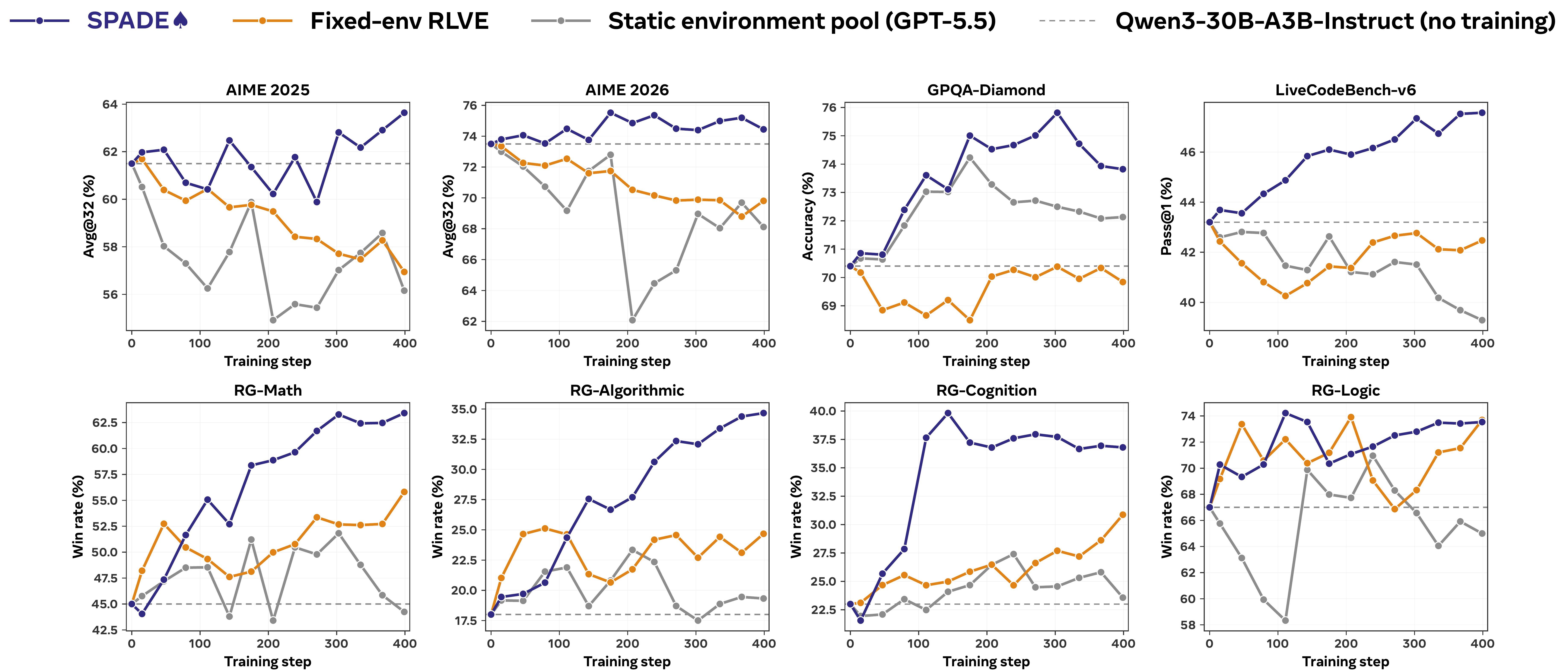
At 30B-A3B, SPADE reaches a suite average of 58.3: +8.1 over the base model and +5.3 over the strongest fixed-environment baseline, and the margin holds at every scale. The generated games contain none of the evaluated content, yet the reasoning skills transfer to mathematics, science, and code. The gap widens as models get bigger.
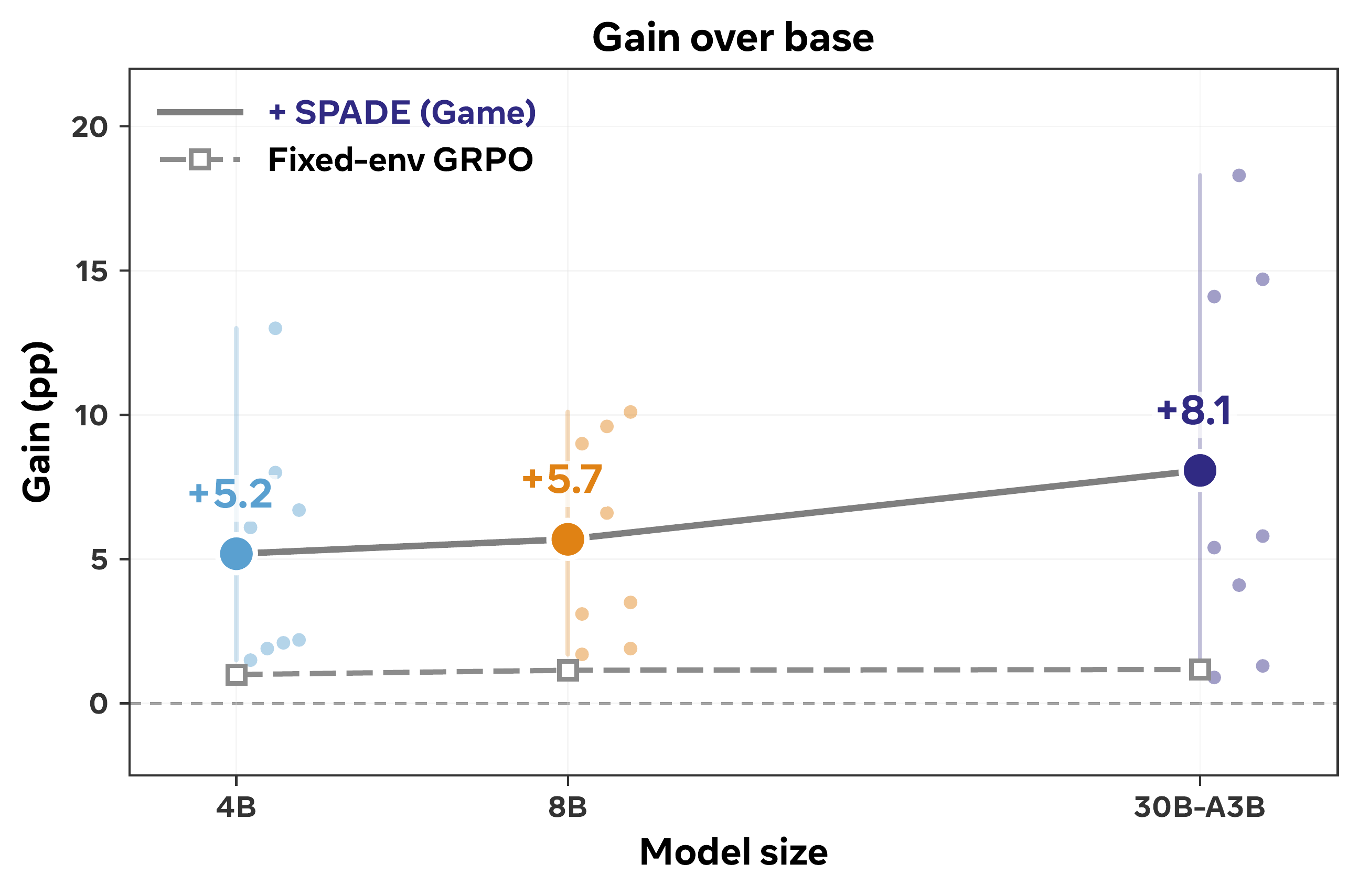
This is the core of the thesis. A fixed set of environments is a fixed amount of signal: a bigger model fits it faster and then plateaus, so the gain stays flat near +1.2 no matter the scale. An adaptive curriculum keeps producing new frontier environments as the Agent climbs, so the gain grows with capability. The better the learner, the more a moving curriculum is worth.
The Designer Adapts to the Agent
An adaptive curriculum is only real if the Designer keeps supplying environments the Agent can actually learn from, and keeps making them harder as the Agent improves. The generation prompt is byte-identical across all 400 training steps, so anything that changes traces to Designer training, not to new instructions. Two code-level measurements move together, and a third holds the difficulty at the frontier.
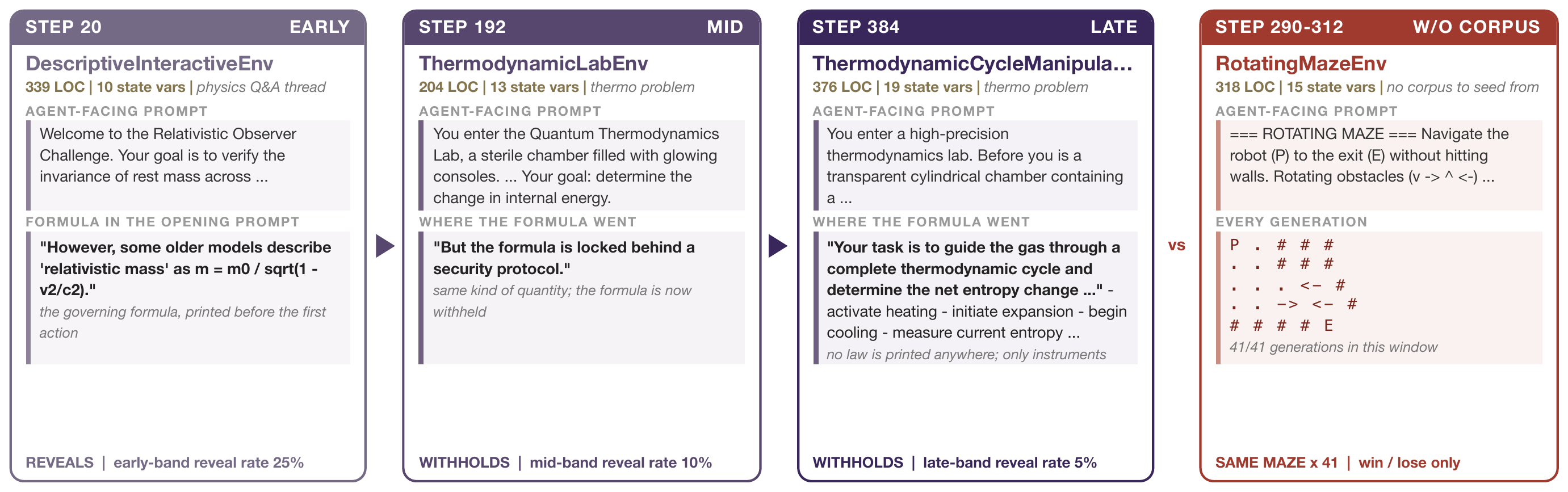
First, environments stop giving the answer away: the fraction of physics environments that print the governing formula in the opening observation falls from 25% to 5%, across the 473 physics environments of the run. Second, rewards become more finely graded, from 3.7 to 5.8 distinct levels per environment, while the program length stays flat (325 to 333 lines, correlation 0.05 with reward levels), so the added structure comes from smarter grading, not longer code. And the Designer keeps the difficulty pinned to the frontier: across the run it holds roughly a third of every batch of environments in the learnable band, where the Agent wins between 20% and 80% of the time, through step 400.
That red panel above is my favorite failure. Strip out the corpus grounding and the Designer collapses onto a single idea: over steps 290 to 312 it emits the exact same rotating-maze environment forty-one times in a row. Grounding is what keeps the worlds diverse; on an embedding map, corpus-grounded environments fill the space (an effective-diversity score of 0.68) while the ungrounded ones huddle into a single blob (0.04). The corpus buys breadth, and the regret reward turns that breadth into difficulty.
You can see this directly. Below is a 2D map of 4,976 environments the Designer wrote across training, each embedded with SBERT and projected with t-SNE, one dot per environment. Toggle the runs: full SPADE (purple) spreads across the whole space, while the no-corpus ablation (red) stacks its near-duplicates into dense clumps, the collapse made visible as saturation.
The Agent’s side of the loop shifts to match. Early in training it reasons entirely up front and cannot recover once the interface rejects its answer; by the middle it tests short hypotheses and revises them as results come back; late in training it gathers evidence first and derives once, when the evidence is enough. It learns to act on what the environment tells it, not only to reason everything out up front. Its ability to produce a long derivation stays intact.
All Three Ingredients Matter
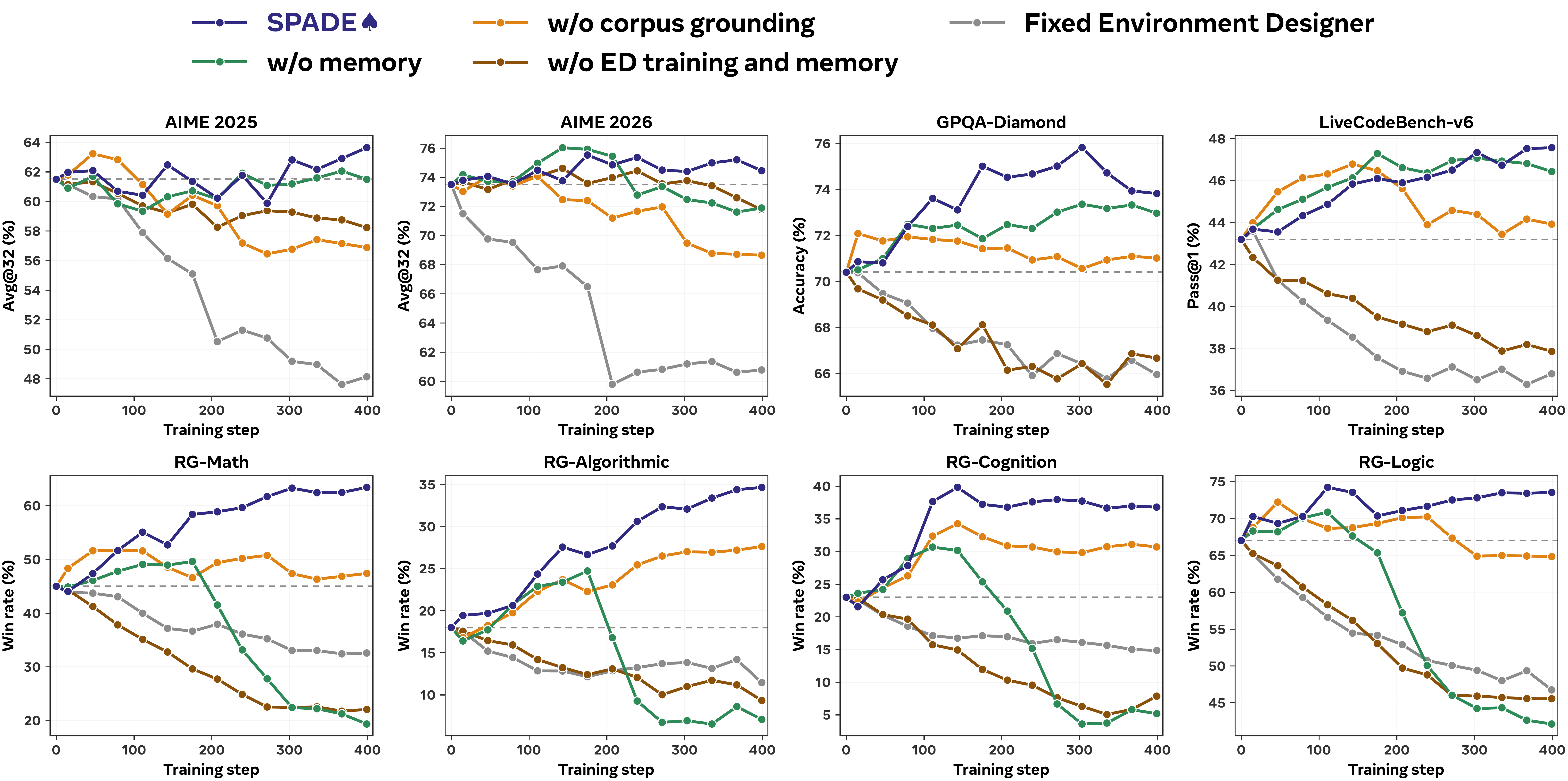
The three ingredients are not optional; removing any one costs at least 4.8 suite-average points. The sharpest result is about training the Designer at all. Freeze it and drop the memory, and the model gets worse than no training: the suite average falls 9.7 points below the untrained base, because a frozen designer keeps generating environments the Agent has already outgrown. Even replacing the self-play Designer with a fixed frontier model (GPT-5.5), while keeping corpus grounding, recovers only about 35% of SPADE’s gain and does not improve code at all. The non-adaptive and single-component variants all peak early and then fade; full SPADE keeps climbing to the end. The value is not in any one clever environment. It is in a designer that adapts to the Agent as the Agent learns.
The Same Recipe Reaches Multi-Turn Tool Use
Everything above is the games setting: reasoning skills learned in self-designed puzzles. The same recipe works for tool use. Here the Designer writes tool-use environments: a set of simulated tools in function-calling format, a backend state they modify, and several natural-language user instructions that arrive one at a time. It lifts real agentic benchmarks too.
| Benchmark (30B-A3B) | Base | + SPADE | Δ |
|---|---|---|---|
| BFCL v4 (multi-turn) | 49.0 | 54.7 | +5.7 |
| τ2-bench | 49.0 | 52.6 | +3.6 |
| ACEBench-Agent | 62.0 | 75.9 | +13.9 |
This is the answer to why the environment matters in the agentic era. The benchmarks that gain most are the ones whose long-horizon, stateful structure the Designer learned to reproduce. The structural training signal (learning to plan across turns and act on returned state) transfers to real tool use, even to domains where task-specific training data does not exist. One interface, from a single-step math check to a twelve-turn tool-calling task, and the same self-play loop trains both.
Where This Is Heading: Automating the Rest of the Pipeline
Step back to see what SPADE is a piece of. Building a frontier model has become a recognizable pipeline: pretraining, then mid-training, then a post-training stage of RL on environments with verifiable rewards. Each stage is increasingly a known recipe, executed by hand. Recursive self-improvement, read plainly, is what happens when the AI starts walking through that recipe and automating it, stage by stage, instead of waiting for us to.
Conclusion
SPADE makes environment design a learnable component of post-training through self-play. A single model plays an Environment Designer that writes complete environments as executable Python and a Reasoning Agent that learns to solve them, and a hint-based regret reward keeps every environment at the Agent’s frontier. Concretely, SPADE:
-
Beats fixed-environment training, and the margin grows with scale. +5.3 over the strongest fixed-environment baseline at 30B-A3B (+8.1 over base), while a matched-budget fixed pool stays near +1.2 at every size, because an adaptive curriculum keeps producing frontier environments a bigger model can still learn from.
-
Produces a genuinely adaptive curriculum. With training alone, the Designer stops revealing solutions (formula reveals fall 25% to 5%), grades reward more finely (3.7 to 5.8 levels per environment), and holds roughly a third of every batch in the learnable band through the whole run. Remove the corpus and it collapses to the same environment 41 times in a row.
-
Needs all three ingredients. Designer training, corpus grounding, and environment memory each carry at least 4.8 suite-average points; a frozen designer, even a stronger frontier one, recovers only about 35% of the gain.
-
Reaches real multi-turn agentic tool use. The same recipe lifts BFCL v4 multi-turn (+5.7) and ACEBench-Agent (+13.9) at 30B, with the largest gains where the benchmark’s long-horizon structure matches the environments the Designer learned to write.
The takeaway continues the one from SPIRAL and SPICE. A self-improving system needs an ever-expanding supply of its own goals, and the way to get one is to stop treating the environment as fixed. Point the model at the task of building its own worlds, and the curriculum opens back up.
The agenda that began with SPIRAL and continued through SPICE was always heading here: a model that generates experience of its own, not just reads ours. SPADE hands it the environments. The reward, the curriculum, and the learning rule are still ours to write; hand those over too, and the model runs its own training loop, open-endedly, improving long after we step back.
Enjoy Reading This Article?
Here are some more articles you might like to read next:
- SPICE: Self-Play In Corpus Environments Improves Reasoning
- SPIRAL: Self-Play on Zero-Sum Games Incentivizes Reasoning via Multi-Agent Multi-Turn Reinforcement Learning
- TorchOpt: An Efficient Library for Differentiable Optimization